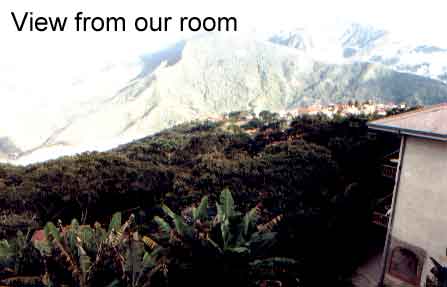
May 15 – The World’s Most Dangerous Road
I woke up several times in the middle of the night – sometimes to pee, sometimes to catch my breath, sometimes to wince at the excruciating pain in my ribs. Every travel book and every traveler we passed warned us of altitude sickness but at this point I can’t figure out where my imagination stops and reality begins.
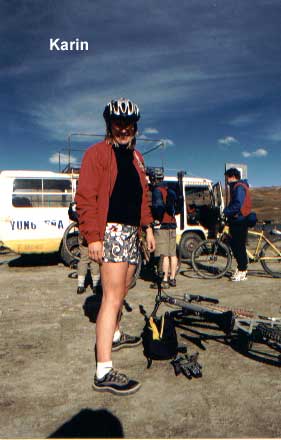
By 6am we were up and fed french toast and coca tea. At this altitude water boils at 88oF so it takes extra long to cook things. While we waited for our second batch of tea to boil we picked out real mountain biking wardrobes before the bus came at 7 to take us atop the World’s Most Dangerous Road. Karin helps maintain Gravity Mountain Biking, a company that runs mountain bike tours through the greater Bolivian landscape. Her theory is that by arriving to La Paz last night, The Collins and I will trick our bodies into acclimating to the altitude by taking us up to 16,000 feet this morning and down to 4,000 feet by this afternoon, via bicycle, before the sickness hits (usually after 24 hours).
Our two guides, Mike and Travis, met us at Karin’s and we all headed toward the Gravity bike yard. Our driver, Pablo, was a local whose gold smile was suspiciously chipper for the early hour. I could not make out a word of his local Spanish dialect, it was super relaxed and seemed to have no inflections or consonants. When the gringos talked to him their Spanish would fluctuate between textbook rigidity and Pablo’s lethargic tongue. It was very hard to follow.
Rocky, the Gravity’s yard dog, was a Boxer puppy with a bad case of drip-dick
and an urge to chase after every pack of dogs that wandered by (and there
were many). We took turns chasing after him and loading the bikes onto
the bus.
Every few minutes I found myself taking slow, deep breaths which prompted anxiety over when the altitude sickness was gonna kick in. We’re told, if there’s one thing that brings the sickness on quicker and harder it’s physical exertion.
We picked up about 15 other riders waiting at a pre-determined coffee shop then headed towards La Cumbre, our departure point. Once there we were given brief instructions, fitted for our bikes, and told to either haul ass and stay up front, or lag and stay with the heels. There were other instructions but I had such bloating gas I couldn’t pee and therefore couldn’t pay attention. I tried to pee once at the bike yard and twice by the side of a lake in La Cumbre an hour later. No luck either time. Of course, the longer one holds it in the harder it is for one to let it go.
The first twenty minutes of the ride was intense. I was on a new bike dialed to go Fast. We were zooming down a windy road with oncoming traffic, and I had pee backing up in the form of tears.
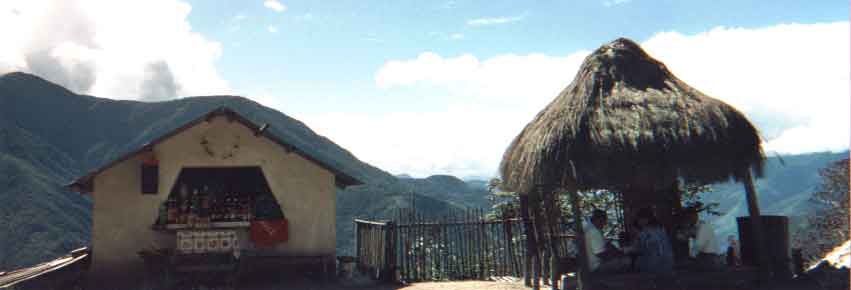
Our first stop was a clearing that gave us our first hint of the upcoming topography. We could see for miles around and down into the canyon we were about to bomb. With no clouds the air had a cold bite to it. The spectacular view rang bright and endless. It was all so beautiful I hardly noticed I had been peeing for a couple minutes until Robert made some comment.
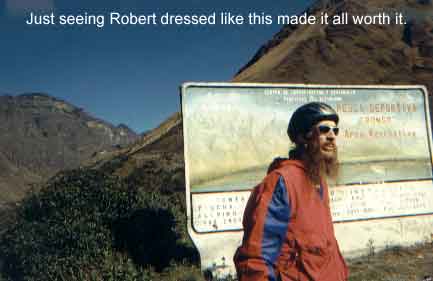
Speaking of Robert, he was wearing not only
shorts, but also a red sports parka, finger-less biking gloves, aerodynamic
helmet and wrap-around sunglasses.
The next 20 miles went smoothly and quickly. Very quickly. I was getting very accustomed to my bike and finding the most efficient techniques for increasing speed and diminishing resistance. We rolled at a steady 70kph, rounding turns and passing busses, slowing only at inclines and a few photogenic vistas. The quick descent brought us to more temperate weather and the clothes started coming off in layers. Eventually our pack of riders convened just outside a small town with no noticeable name or purpose. We were told "the World’s Most Dangerous Road officially begins here."
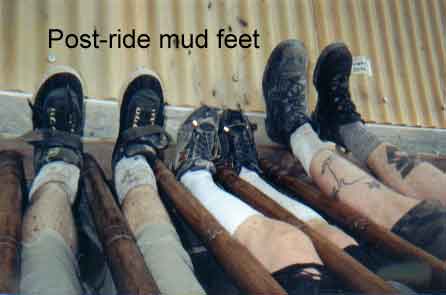
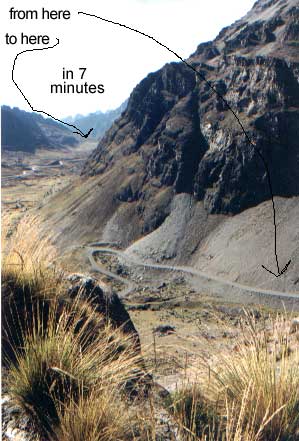
We had entered a menacing cloudbank and the visibility fell sharply, unlike the temperature. The paved road gave way to loose ruble (and mud when we were lucky). The route also slimmed down to one lane and rarely went more than 100 meters before making a sharp turn around the mountainside.
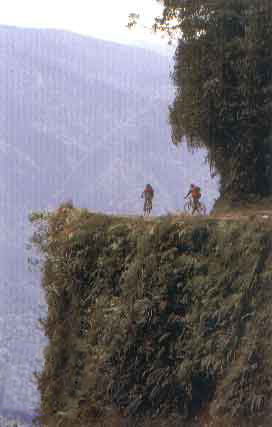
The Andes are widely referred to as "what other mountains want to be when
they grow up." This became frighteningly clear when the clouds cleared
and we could see just how harrowing our one-lane road was - at best it
was but a scratch on the side of the 500 meter vertical rock face. Kinda
made me forget about the other hazards we were warned about: local campesinos
throwing rocks at passer-bys and/or bombing out portions of the road,
oncoming traffic, bandits, brake failure, waterfalls, landslides, falling
rocks, dehydration, sunburn, malarial mosquitoes…
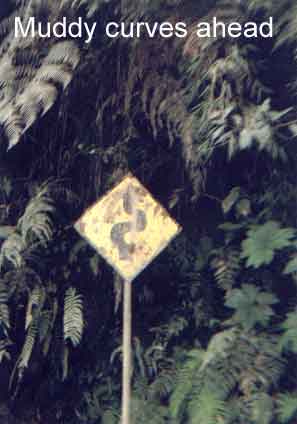
The next couple miles were summed up by a standard diamond-shaped
yellow curves ahead road sign that was hardly discernable behind
all the mud splattered on it. It is easy to keep mud from flying off the
front tire and into your face if you are going straight. The frame usually
blocks it. But the endlessly twisting road kept a steady jet of wet dirt
and muck flowing from my tire to my mouth and nose. And what started as
a Rorschach pattern on my back quickly morphed into a mud shell as more
and more dirt caked into it.
The further we descended and the closer we got to the outskirts of the
jungle the more the road started to dry out and the hotter it became.
We made periodic stops to regroup, do a head count, eat a banana, apply
sunscreen and mosquito repellent, and take note of some recent bicyclist/tourist
bus/farmer truck that had gone over the edge and into oblivion.
Where I live – in a region with no bike awareness whatsoever – every time I make it home from biking across town I feel I’ve cheated death. I am accustomed to weaving through traffic and avoiding negligent drivers (and their doors). What I am not accustomed to is dodging traffic while also on a rocky incline with eminent death to my left. At our speed it helps to have the path of least resistance – in our case, the very outside 24 inches of the road where the rubble and broken rock become a loose, powdery dust. This may seem scary – and it is – but it is so much faster and smoother. The real danger is when you approach a part of the road that has crumbled away and you can’t see the gap until you’re bunny-hopping over it, and you can look down past your peddles and see hundreds of feet between you and where the mountain starts to level out.
WHN? in Sudamerica - May 2002
Day
0 – Please wake me for meals.
/ Day 1
– Eu como minha propia merda.
Day 2
– Headbangs, Cumstains, and Clogged Shower Drains (aka Devon’s 33nd Birthday)
Day 3
– Banana Pizza – Don’t Knock It ‘Til You’ve Tried It
Day 4
– "Fuck My Ass!" the group of girls in the front row kept chanting.
Day 5
– Doesn’t anybody speak English around here?
Day 9
– I am Yellowman.
Day 10
– I am apparently also an idiot.
Day 11
– A gas station with a bar...Why didn’t I think of that?!
Day 12 –
What doesn’t kill you, usually still hurts a lot. (aka Mother’s Day)
/ Day 13
– Touring isn’t so much a question of "Where is my next meal coming
from?" as much as "Where/when am I gonna be able to take my
next dump?"
__________________________________________
Non-band travel
May 14
– Random Acts of Meat.
May 15 – The World’s Most Dangerous Road
May 16
– Another day in paradise
May 17
– They’ve had the same government since we got here!
May 18
– Why are my teeth turning green?
May 19
– Hey dad, I’m in jail!
May 20
– Never Let The Truth Get In The Way Of A Good Story.
May 21
– The sun and the moon, all in one afternoon.
May 22
– The Royal Frankenstein
May 23
– Metal? You call this metal?!?
May 24
– Machu Picchu or Bust (your travel agent over the head).
May 25
– There she is! What do I do?! What do I do?! Nothing, as usual.
May 26
– Maybe I was supposed to be naked.
May 27 – Be aware or be prepared
May 28 – Fried Food Day