- "Music is actually secondary to what we do," says Craig Billmeier,
bassist for San Francisco-based punk outfit All You Can Eat.
-
-
- With duct tape-wrapped, shoulder-length dread locks, Billmeier hardly
looks the part of a budding rock star, which is exactly the point.
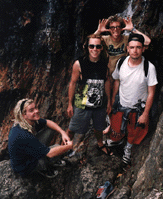
Billmeier, 22, and band
 mates
Devon Morf, 26, Danny Buzzard, 25, and Myron Isaacs, 29, have joined
the growing ranks of bands seeking to redefine the roll of music in
our culture. Rather than take advantage of punk music fans, the band
focuses on the opportunities to travel and make friends in the United
States and abroad. mates
Devon Morf, 26, Danny Buzzard, 25, and Myron Isaacs, 29, have joined
the growing ranks of bands seeking to redefine the roll of music in
our culture. Rather than take advantage of punk music fans, the band
focuses on the opportunities to travel and make friends in the United
States and abroad.
- When the band played in Brazil, it took little more than the request
of one kid and the opportunity to play somewhere new to get the band
interested.
- "We did it because I got a letter from a kid in Brazil saying 'Play
here, play here,'" says vocalist Morf. "The kids were 16 and had never
booked a show."
- By way of underground fanzines and other connections, Morf found
other kids in Brazil interested in having an American band play and
put the responsibility of setting up the show into the youths' hands.
A venue was found, transportation was arranged and the rest is history.
Touring is still expensive, and the band still has a $2,000 debt from
their last tour. Yet few bands get the opportunity to perform in these
countries. Morf says that frequently a show in another city is set
up by having three contacts in an area who know how to set up a show.
Most of the planning is done hoping that the people setting up the
show will follow through on their end of the deal.
- "We go into a place and get the people involved," says Morf. "A
lot of the people at the shows are the people involved in setting
up the shows."
- Morf, looking equally eccentric with his shaved head and 50s-era
glasses, serves as the acknowledged driving force of the band. Morf
stresses that none of the members want to make money or to be successful
in the traditional sense. "All You Can Eat is just four guys having
fun," says Morf. "The initial founding of the band was to do our own
seven-inch and tour the United States."
- The band has achieved that and more. Since its inception in 1989,
the band has released two CDs, approximately of 15 singles and has
songs featured on roughly 30 compilations. In addition, the band has
toured the United States, Japan, New Zealand, Australia, Thailand,
Hong Kong, Uruguay, Brazil and Argentina.
 Self-described as a bunch of goofy dorks who like toys and comic books,
the band cranks out its unique blend of diverse and melodic hardcore
in an energizing fashion that wills the audience to get involved.
Self-described as a bunch of goofy dorks who like toys and comic books,
the band cranks out its unique blend of diverse and melodic hardcore
in an energizing fashion that wills the audience to get involved.
- All You Can Eat represents a growing underground movement within
the rock and roll community. Based on the DIY (Do-It-Yourself) philosophy
spawned by such now legendary punk rock groups as The Misfits and
Black Flag, a new generation of musicians is turning its back on major
label record companies in favor of a more grass-roots approach.
- The band prides itself more on its incredible energy than its music.
Aaron Muentz, editor of The Probe, a Bay Area music fanzine, says
that the band is hard not to like, and always entertaining .
- "People can't be passive," says Muentz. "Devon gets them into it.
He's not obnoxious about it either."
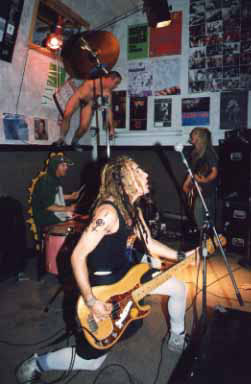
- At a show in a San Leandro residence a few years back, Morf had
the audience jumping off couches into an out-of-control dog pile as
he sang, wrapped in duct tape, wearing nothing but a pair of mirrored
sunglasses.
 When
asked what they thought of the band after the show, many of the exhausted
audience members said they couldn't remember a lick of the music,
but they knew they had fun. The band wouldn't have it any other way.
"We're goofy," says Billmeier. "We're fun live. It is the best attribute
of the band." When
asked what they thought of the band after the show, many of the exhausted
audience members said they couldn't remember a lick of the music,
but they knew they had fun. The band wouldn't have it any other way.
"We're goofy," says Billmeier. "We're fun live. It is the best attribute
of the band."
- Morf says, "We put the best show on for the kids who come to see
us." In some ways, he says, he would really rather play someone's
living room than on stage, because that way the band can establish
more of a real connection with the fans and create less of a pretentious
rock band atmosphere.
- Morf's words are backed by his actions. When the police shut down
the band's most recent gig, Morf and the other members of All You
Can Eat invited friends, fans and members of other bands back to Billmeier's
apartment to sleep and watch videos before the band went to Oregon
the next day.
- The band stays away from corporate sponsorship, although members
of the band insist they do not wear their resistance as a badge. The
idea of resisting corporate involvement is fast becoming one of the
staples of the modern punk movement. Bands like Green Day and The
Offspring have been criticized harshly by the fans and media for achieving
success by way of major label contracts and MTV.
- "They don't have a fear of it," says Muentz in regard to All You
Can Eat's aversion to big business. "It is more about making friends
and getting to travel and see different cultures. Playing is an excuse
to do those things."
- In the past, bands featuring experimental or non-mainstream music
found it difficult to get their music heard, much less book a tour.
The Misfits, the seminal horror movie punk outfit that played from
1977 to 1983, popularized the trend of putting out cheap seven-inch
singles as a way of getting their music heard. Seven-inch singles,
a dying format for music distribution, could be produced by the band
cheaply and give fans a collectable way to follow the band. Black
Flag, another of the movement's grandfathers, made its mark via its
breakneck touring schedule, playing multiple dates to scaled down
audiences. The movement has grown immensely since its infancy in the
70s and a whole philosophy of life and ethic has grown up with it.
- Scott Jones, an employee at City Records in Pleasanton, California
says the bands fear losing face with the fans more than they worry
about selling out.
- "I think they want to appear that they have integrity," says Jones.
"I mean, look at Ian MacKaye and Fugazi. He's been doing that for
years. His CDs are seldom more than $8."
- Record company executives and agents often decide what the average
music listener gets to hear. MTV, the original television music station,
has formed a monopoly and placed itself in a position to dictate what
will play and what will not play. Much of the independent rock scene
is a reaction to the MTV "Buzz Clip" mentality, in which MTV makes
a band the flavor of the week, only to unceremoniously dump the band
when ratings slide. Fans of All You Can Eat and its kin have found
a way through underground networks to allow people access to true
alternative rock.
- More important than maintaining integrity, many bands like All
You Can Eat feel that signing to a major label robs the fans of the
special relationships independent punk outfits share with the audience.
- Alex Koll, a fan who is part of the grass-roots connection that
helps punk bands stay afloat, says that a band that signs with a major
label is turning its back on the audience.
- "A lot of times the bands that you really liked gave you something,"
says Koll. "They set up a connection between you and them that was
kind of personal, and they turned that connection into a commodity."
- Morf and Billmeier maintain that corporate involvement would eventually
ruin the fun by limiting their control over their music. On a tour
through Japan, the band got wind that one of the largest Japanese
newspapers was promoting the band, an extremely disheartening development
for vocalist Morf. Part of the band credo is based on the idea that
they do not want to have the dirty deeds of some corporate monster
on their conscience. That, fueled with the idea that they would never
want to be in a position where they had to write music to make a living,
is definitely part of the band's appeal.
- Morf is aware that many in the underground punk scene see All You
Can Eat as the perfect example of what punk rock music should be about.
Punk bands engage in a lot of infighting and back stabbing, amidst
charges of selling out. All You Can Eat wants to stay clear of that
debate. And while the band is more politically than artistically motivated,
Morf and Billmeier don't want to carry the burden of being known as
the most political correct band. They simply want to follow their
own consciences.
- "We don't have a political agenda," says Morf. "We're not perfect
angels." The band has seen its name and image pop up in corporate
publications and programs like Metal Edge and MTV. In addition, some
of the band's music has been re-released by a fan in Australia. Still,
the lure of fame is not what the band wants. Ideally, the band will
stay at street level for its entire existence.
- If the band does not crave commercial success, then what will become
of them when their playing days are over? Many bands, having either
run out of money, or not having made any in the first place, eventually
sign with a record company in order to pay the bills. The members
of All You Can Eat have planned on life after music. Morf has a B.A.
in journalism and has written articles for such widely known punk
scene magazines as Flipside and Maximum Rock and Roll. Billmeier has
recently returned to college after having dropped out when joining
the band.
- Ultimately, the band members want the band to be together forever.
While at some point reality dictates that the band members will move
on to pursue other goals, Morf and Billmeier feel that they will still
play whenever they can get together. "We're like the A-team," says
Morf. "I want to be able to say 'we are getting the band back together.'"
Billmeier agrees, "We could play on a beach with our families there."
- The band isn't really concerned with what people think of the music,
because foreign audiences often have no idea what the whole punk movement
is about. In fact, many people in the states have no idea what the
punk movement is about. The band gets all different types in its audience
as it travels around the globe.
- "A lot of the places we go to, our music is pretty foreign. People
with white hair, yuppies smoking pipes," says Billmeier. "We played
to a Chinese college, and they were not cultured to punk at all."
- For many audiences, American music itself may be totally foreign.
When the band is in other countries, the exchange of friendship and
ideas is more at the root of what the band seeks.
- "I gained more knowledge than I could in school," says Billmeier.
"I know this sounds clichŽ, but it's all about breaking down barriers."
- Refreshingly, the band seems to be more interested in the world
around it than in making a quick buck off of ever-present, angst-ridden
teens. On a basic level the band may be nothing more than four guys
having fun. But in the bigger picture, the band is about bringing
music to the people in an attempt to gain knowledge and experiences
in a way that most bands never will. Billmeier says All You Can Eat
is helping to create a network so that any band can do what they have
done.
- Peter Wagner, an 18-year-old freshman at Oregon State, has recently
become part of the grass-roots network on which All You Can Eat depends.
- "I let it be known before I even came up here that I wanted to
put shows on at school," says Wagner. "So if anyone was on tour, or
wanted to explore Oregon, they could give me a call."
- Sporting recently-dyed black hair and a bushy goatee, Wagner hangs
up flyers, sets up performances, and provides floor sleep space to
bands passing through the area. People like Wagner have taken the
place of booking agencies for small bands.
- Morf eventually would like All You Can Eat to tour every continent.
- "Right now, I'm looking into Antarctica," says Morf, grinning.
|